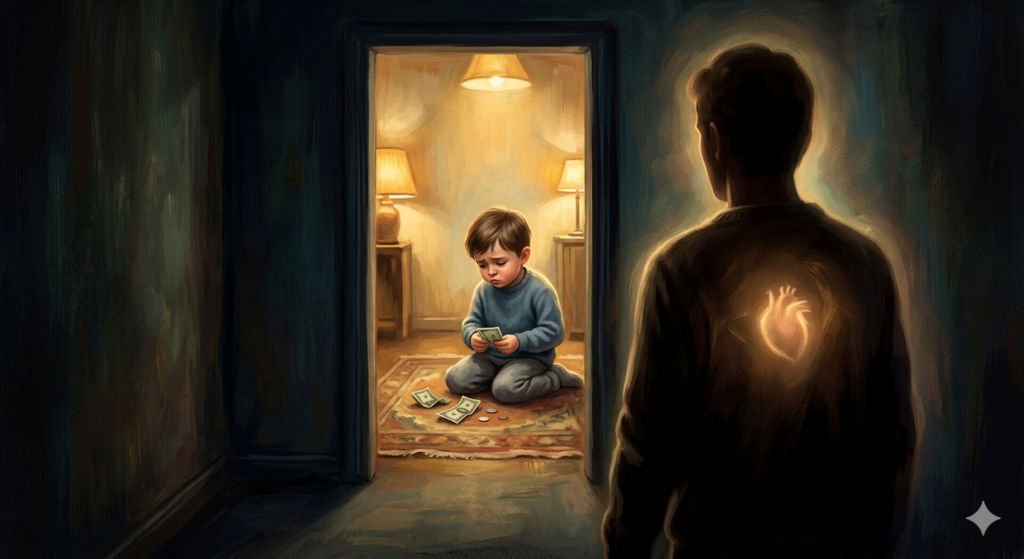
Imagine your mind as a garden. If seeds of fear and instability were planted there years ago, you cannot blame yourself for growing weeds today. The first step involves not frantic weeding but understanding the soil itself. Childhood money wounds often act as these buried seeds, silently shaping our financial habits long into adulthood.
In this post, we will break down three specific childhood environments. We will explore how each one creates very specific—and often frustrating—money habits in our daily lives. More importantly, we will learn to recognize these patterns without judgment.
Table of Contents
The Instability Pattern
Childhood money wounds from unstable environments leave a distinct mark on our psychology. When money arrived unpredictably during your formative years, your brain learned one critical lesson: survival depends on control. This need for control doesn’t disappear when you grow up and achieve stability.
The nervous system continues scanning for threats, often seeing danger where none exists. It drives behaviors that made sense in an unpredictable home but create problems in a stable adult life.
Common Behaviors
If you grew up with instability, you might hoard money out of a deep fear of future loss. Every dollar feels like a security blanket you cannot afford to lose. Conversely, you might overspend impulsively to experience a fleeting sense of power and normalcy.
You might also avoid investing or taking calculated risks. The stock market or a business venture feels like a threat because your brain learned that the future holds danger, not opportunity. Both responses stem from the same root: a childhood where money meant survival.

The Loss Pattern
Childhood money wounds from sudden loss teach the brain a devastating lesson: safety remains an illusion. When a family loses a home or a parent loses a job without warning, the child internalizes a worldview where everything can disappear instantly. This belief burrows deep into the subconscious.
As an adult, you might not remember the event consciously. Yet your body remembers the feeling, and it makes decisions based on that old data. It chooses perceived safety over potential gain every single time.
Common Behaviors
If you experienced a sudden loss, you might avoid planning for the future altogether. Thoughts like “Why bother? It might get taken away anyway and can surface whenever you try to set long-term goals. This defense mechanism protects you from the pain of potential loss, but it also prevents you from building anything lasting.
You might also struggle to trust yourself. Constant second-guessing plagues your decisions, leaving you paralyzed between options. If the rug once got pulled out from under you, trusting your own choices feels terrifyingly risky.
The Shame Pattern
Childhood money wounds from shame cut deepest into our sense of self-worth. If caregivers shamed you for asking for money or made you feel like a burden, you learned a painful lesson: wanting things makes you bad. This message attaches itself to every desire, every ambition, and every financial need that arises.
Unlike instability or loss, shame attacks your identity directly. It tells you that you don’t deserve to have your needs met. It whispers that abundance belongs to other people, not to someone like you.
Common Behaviors
If you grew up with financial shame, you might undercharge for your services or avoid asking for raises entirely. Asking for more money feels like exposing your greed, confirming the “badness” you learned to associate with wanting. You settle for less to stay safe from that internal accusation.
You might also sabotage opportunities when they appear. A big client comes along, and you drop the ball. A promotion becomes available, and you fail to apply. Deep down, you don’t feel worthy of abundance, so your actions ensure you never receive it.

Recognizing the Garden
Childhood money wounds create behaviors that look like character flaws from the outside. Friends might call you cheap, reckless, or unmotivated. You might call yourself those same names internally. But these labels miss the point entirely.
These patterns are survival mechanisms that have simply outlived their usefulness. They protected you once in an environment where they made sense. The goal now involves not judging them but simply recognizing them for what they are.
The conclusion
Once you recognize the soil, you can change what grows there. Childhood money wounds lose their power when you bring them into conscious awareness. You can pause before reacting and ask yourself, “Am I responding to today’s reality or to an old echo?”
This awareness creates space for new choices. You can learn to take small risks, to trust yourself gradually, and to accept that you deserve abundance. The garden can grow something new, but only after you understand the soil beneath it.
Answers To Some Questions
This behavior points to what the blog describes as the Shame Pattern. If caregivers shamed you for asking for money or made you feel like a burden, you may have internalized the belief that wanting things makes you bad. Asking for more money—whether through a raise, a promotion, or fair pricing—can feel like exposing your greed and confirming that old shame. Sabotage becomes a way to stay safe from that internal accusation. Deep down, you may not feel worthy of abundance, so your actions unconsciously ensure you never receive it. The goal is not to judge this response but to recognize it as an old echo rather than a reflection of your true worth.
This pattern often traces back to what the blog calls the Instability Pattern. If money arrived unpredictably during your childhood—some weeks abundant, other weeks scarce—your brain learned that survival depends on control. Even though your financial situation has stabilized, your nervous system continues scanning for threats. Hoarding becomes a form of security, a way of protecting yourself against a future loss that your subconscious still expects. The behavior made sense in an unpredictable home, but now it’s a survival mechanism that has outlived its usefulness. Recognizing this is the first step toward loosening its grip.
You May Also Like These
- Your Past & Your Wallet: 3 Childhood Money Wounds
- Why Budgeting Won’t Fix Financial Trauma
- The Psychology of Spending: How Fear-Driven Beliefs Keep You Broke
- Thinking Like a Wealth Builder: How to Shift from Survival Mode to Legacy Mode
- From Survival Mode to Financial Stability: Why Income is Only the First Step
Sign up for our Newsletters