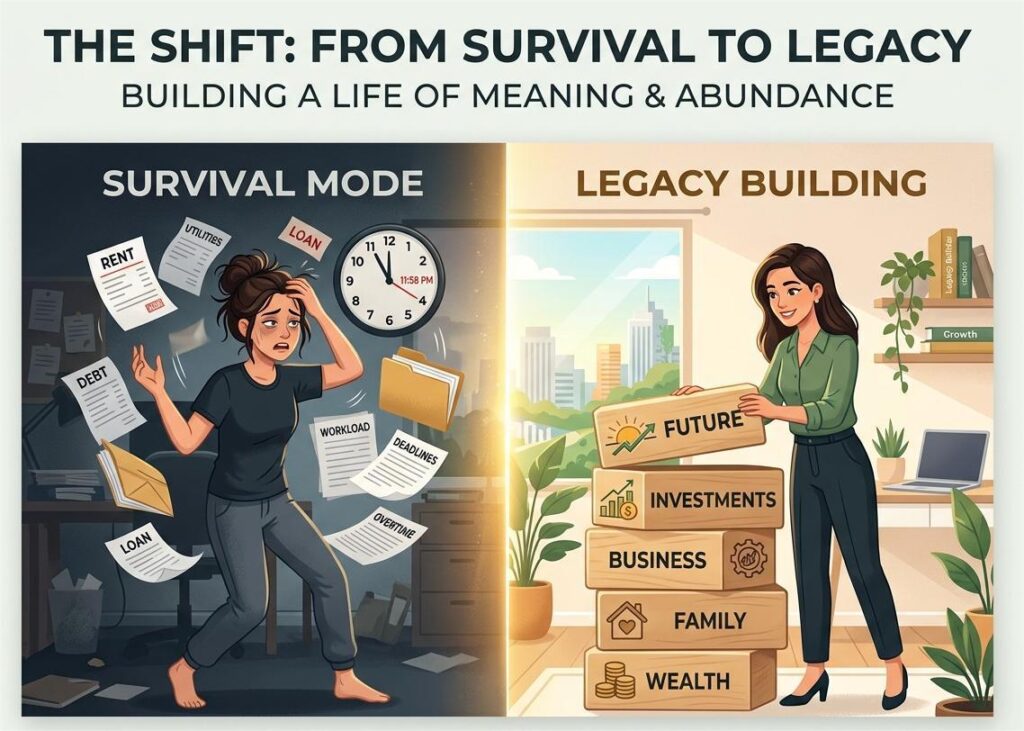
Most people want to be wealthy, but very few actually think like wealth builders. If you feel stuck in a cycle of living paycheck to paycheck, or if you have achieved financial stability but can’t seem to get ahead, the issue is rarely your income level. More often, it is your money mindset.
The difference between those who stay stuck in survival mode and those who build lasting, generational wealth comes down to one core principle: Wealth builders think in decades, not months.
They make decisions today that their future selves—and their future generations—will thank them for.
Whether you are just starting your journey toward financial stability or you are ready to build a legacy, this mindset shift is the foundation. Let’s break down what it means to think like a wealth builder with clarity, wisdom, and faith.
Table of Contents
Wealth Builders Practice Delayed Gratification
The most immediate difference between a short-term thinker and a long-term wealth builder is how they answer a simple question.
Short-term thinkers ask, “What feels good right now?”
Wealth builders ask, “What will this decision produce in 5, 10, or 20 years?”
Escaping survival mode requires you to stop valuing present excitement over future stability. Short-term comfort feels good in the moment, but it anchors you to the starting line. It looks like this:
– Impulse buying
– Emotional spending
– Lifestyle inflation (getting a raise and immediately upgrading your car)
– Chasing trends
– Avoiding financial discomfort
In contrast, a long-term strategy requires intentional discomfort. It looks like this:
– Saving before spending
– Investing consistently, even when the market is scary
– Choosing assets over lifestyle upgrades
– Saying “not now” to say “yes” later
– Prioritising future stability over present excitement
Wealth is built by people who can delay gratification.

Wealth Builders Think Like Investors, Not Consumers
To shift your money mindset, you must change your identity. Are you a consumer, or are you an investor?
Consumers ask, “How can I spend this money?”
Investors ask, “How can this money grow?”
Consumers buy things that provide a fleeting hit of dopamine but lose value immediately:
– Clothes
– Gadgets
– Lifestyle upgrades
– Entertainment
Investors buy things that work for them while they sleep:
– Stocks and ETFs
– Real estate
– Businesses
– Skills that increase earning power
– Systems and intellectual property
The difference is simple but profound: Consumers spend money. Investors multiply it. If you want to move from survival mode to financial stability, you must stop looking at your income as a pool of cash to be drained and start seeing it as a seed to be planted.
Short-term thinkers want to look wealthy. Long-term thinkers want to be wealthy.
Chinonyelum Lynda
Wealth Builders Focus on Assets, Not Appearances
This is a hard truth, but it is essential: short-term thinkers want to look wealthy. Long-term thinkers want to be wealthy.
Society often pressures us to display our success. We buy the fancy car, the designer bag, or the bigger house to signal to the world that we have “made it.” But wealth builders know that these things are often liabilities—they take money out of your pocket through maintenance, depreciation, and debt.
Wealth builders prioritize assets. Assets are things that produce income or appreciate:
– Investments and property
– Businesses and side ventures
– Intellectual property (books, courses, patents)
– Digital products
– Skills that increase your market value
Liabilities are things that drain your resources:
– High-interest debt
– Lifestyle expenses that don’t generate returns
– Unnecessary upgrades
– Items that lose value the moment you buy them
When you focus on accumulating assets, you build a machine that produces income even when you are sleeping. That is the definition of true wealth.

Wealth Builders Think Generationally
If you are in survival mode, you are likely thinking about how to make it to the end of the week. As you move into financial stability, you start thinking about the end of the month or the year.
But wealth builders operate on a different timeline entirely.
Short-term thinkers plan for the month. Wealth builders plan for the generation.
Generational thinkers ask difficult, forward-looking questions:
– What legacy am I building right now?
– What financial systems will outlive me?
– What foundation am I laying for my children or my community?
– What wisdom am I passing down?
– What financial habits will my family inherit from me?
This is not just a strategy; it is stewardship. It is the recognition that the resources you manage today are meant to serve a purpose far beyond your own comfort.
Faith Integration: Legacy Thinking Is Stewardship Thinking
For those with a faith-based worldview, there can be a tension between planning for the future and trusting in a higher power. Some people believe that planning for tomorrow means they lack faith today.
But we must reframe this: planning is not doubt; planning is wisdom.
Faith is not the absence of structure. Faith is trusting God while building systems that honor the resources He provides. The principles of the Bible consistently point toward the following:
– Stewardship (managing resources wisely)
– Diligence (working hard and with purpose)
– Preparation (like Joseph storing grain for the famine)
– Legacy (passing down blessings)
– Wisdom (seeking counsel and making prudent decisions)
Legacy thinking is faith in action. It says, “I believe God will bless the work of my hands, so I will build something that lasts.”
Answers To Some Questions
Many people assume that higher income automatically leads to financial peace, but income alone cannot create stability. When you’re operating without systems—no budgeting structure, no automation, no investment plan, no long-term strategy—your money has no direction. This leads to emotional spending, lifestyle inflation, and financial overwhelm, even with a high salary. Stability comes from structure, not income. Until you build systems that support your financial life, more money will only magnify existing chaos.
Earning more money does not guarantee building more wealth because of a hidden trap called lifestyle inflation. When your income rises, the pressure to upgrade your lifestyle—buying a nicer car, a bigger house, or more expensive clothes—often rises with it. These purchases feel like rewards, but they are actually liabilities that drain your resources. Wealth builders break this cycle by asking a different question: not “What can I afford now?” but “What will this purchase produce in 10 years?” If you’re getting raises but staying in the same place financially, it’s likely because your spending is rising to meet your income, leaving nothing left to plan for the future.
Why This Mindset Matters for Your Wealth Journey
It is important to understand what actually builds wealth. It is not built by:
– Motivation
– Inspiration
– Good intentions
– Sudden income increases (if lifestyle inflation eats it up)
Wealth is built by:
– Long‑term thinking: Seeing the horizon, not just the hurdle.
– Consistent investing: small, regular actions compounded over time.
– Disciplined habits: Automating your savings and saying no to impulse purchases.
– Strategic planning: Having a roadmap for your money.
– Generational vision: Building for those who come after you.
– Faith-aligned stewardship: Managing your resources with purpose.
When you begin to think like a wealth builder, your decision-making framework shifts entirely. You stop asking, “What do I want now?” and start asking, “What will this create later?”
That one shift changes everything.
You May Also Like These
- Thinking Like a Wealth Builder: How to Shift from Survival Mode to Legacy Mode
- From Survival Mode to Financial Stability: Why Income is Only the First Step
- Too Old to Dream? Think again – Here’s why You’re Right on Time
- Finding Yourself in Foreign Soil: How to Adjust to a New Country Without Losing Who You Are
- How to Plan a Family Vacation Without Losing Your Sanity (or Your Wallet)
Sign up for our Newsletters
The Good News: Anyone Can Learn to Think Long-Term
Perhaps you are reading this and thinking, “That sounds great, but I don’t have enough money to invest.” Or, “I’ve made too many mistakes in the past.”
Here is the liberating truth: You do not need a high income, a perfect past, a wealthy background, or special connections to start thinking like a wealth builder.
All you need is:
– A willingness to adopt a long-term mindset
– The discipline to delay gratification
– A commitment to buying assets instead of liabilities
– A desire to leave a legacy
– Faith (in whatever form that takes for you) to guide your decisions
Wealth is not built in a single moment of luck. It is not built by winning the lottery or landing a massive payday (though those things can help).
Wealth is built over decades.
And the best part? You can start building it today.